
This week it was finally too cold to eat outside, so it’s dinner in the “kotatsu” and dozing off till we can summon the energy to go to bed. Dinner under the stars will be something to look forward to next April maybe.
-
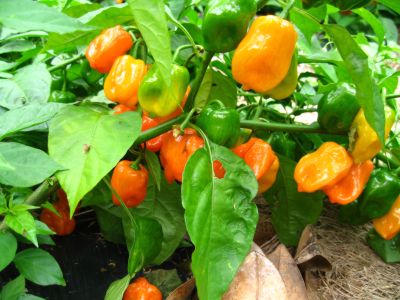
Good crop of Hbaneros this year!
The Habaneros have excelled themselves, even though once they get damaged at all – a split, or a bite by an insect – they go bad very quickly. Even after throwing all the dubious one away I’m still left with far more than I can sanely use, as they’re so hot. I don’t know why I grow them really, except that the aroma when you cut into one is fantastic – strawberries and apricots and a vague hint of something wild and dangerous which you find out all about if you’re silly enough to taste one. I was explaining to Yamamoto-san, who’d dropped in on his way home from a bit of forestry work, that if you wanted to test the hotness of a chilli you touch the cut surface with the tip of your finger, then lick your finger. This works pretty well, but while I was talking I absent-mindedly rubbed the cut chilli so my finger picked up an extra load of juice – enough to put a stop to conversation for 20 minutes while I rushed to the kitchen to find something to ease the burning in my mouth. Milk did no good, but a sip of very sour salty “ume vinegar” helped a bit. Eventually the pain subsided. That’s how hot Habaneros are, though you can tame them a little bit if you use the tip of a knife to remove the seeds and the white pith they’re attached to. Try not to touch the inside of the chilli, and wash your hands, the knife and the cutting board thoroughly afterwards. Even so, your fingers will be hot for a while so don’t touch your eyes or anywhere else with thin skin…
-
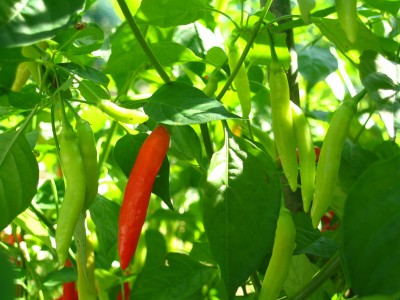
These little "Ishigaki" chillis are also very hot, but aromatic too.
The other chillis I try to grow are a standard Malaysian “red chilli”: biggish, medium heat and a nice red colour, and what I call “Ishigaki” chillis. Some years ago we got some chillis in the market that were marked as being from Ishigaki island in Okinawa. These were the typical “shima” chillis – somewhat cone-shaped, very hot but with little aroma, possibly related to the Thai chilli. I saved the seeds and planted them next year, but what came up was different. This is not so surprising; commercial plants are often hybrids which don’t breed true. The new chillis were straighter in shape, still very hot but with a special fresh, floral aroma, quite different from habaneros. What was surprising was that they have bred consistently since then; each year seeds saved from the previous crop produce the same kind of chillis. This year they’ve done especially well.
- min. temp. 7°C max. 19°C


 asazuke