asazuke

Life in Japan, food, music, whatever…

Farmlog 8th March 2010 20 March, 2010

Filed under: countryside,food & drink — johnraff @ 2:19 pm
Tags: , , , ,

Another cold, windy and cloudy weekend. Sunday evening we had “kasu jiru” – a warming stew, based on “saka gasu” which is what you have left over after fermenting rice and squeezing out the sake. I wonder if Marmite is something similar from yeast after making beer? Anyway the brewery whose sake we stock in Raffles, Takagi Shuzo, also sell sakagasu and it’s better than what you’d buy in the supermarket – comes in a firm but pliable lump and apart from using it in soups and stews you can make a sort of sweet dessert or flatten it out a bit, grill it and nibble it with sake (or beer, but maybe not wine?). I think it would go with cheese too but haven’t tried that yet. Kasu Jiru’s pretty good – apart from the sakagasu base, you put in chunks of salmon, carrot, leeks, “konnyaku”, soy sauce… a very nice winter dish.

A bit nearer Nagoya the “ume” (plum?) blossoms are out already, but up here our trees only have one or two so far. One year our ume were so late they came out together with the cherry blossom, which is usually several weeks later. Even so, Spring is on its way, sort of.

Finished digging up the chilli field, which I should have done last Autumn of course, so the frost could break up the soil and kill the pests. Now it’s time to put the indoor greenhouse together in Nagoya so I can plant the seeds. Chillis need 25°C or so to germinate, which they wouldn’t get till the end of April normally, so to give them a long enough growing season they need some artificial heat to get them started.

Min temp -0.5°C, max 16°C (!)


Farmlog 9th November 2009 2 December, 2009

Filed under: countryside — johnraff @ 1:39 am
Tags: , , , ,

Chillies grow quite well here – the hot Japanese summer is just what they like, and if there’s plenty of sun you’ll get lots of hot colourful fruit. Even the chilly October evenings are coped with OK, but what chillies can’t stand is frost. As soon as the minimum temperature goes below zero, even by half a degree, that’s it. The plants are dead, although if the frost wasn’t too severe you might be able to pick a few more undamaged chillies. Protected by a tough skin, chillies are quite resistant to going bad, but if that gets damaged, by insects or frost, for example, it’s amazing how fast a firm shiny chilli can be turned into a disgusting bag of pus, still held in that skin…

  • min -0.5°C, max – er, I forgot to check…
 

Farmlog 12th October 2009 17 October, 2009

Filed under: countryside,food & drink — johnraff @ 2:54 pm
Tags: , , , , ,

This week it was finally too cold to eat outside, so it’s dinner in the “kotatsu” and dozing off till we can summon the energy to go to bed. Dinner under the stars will be something to look forward to next April maybe.

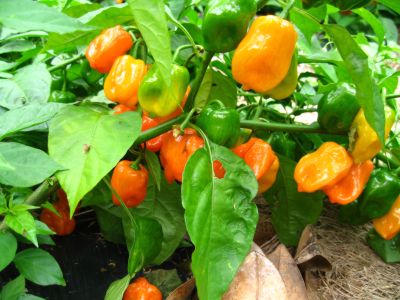
  • Good crop of Hbaneros this year!

    Good crop of Hbaneros this year!

    The Habaneros have excelled themselves, even though once they get damaged at all – a split, or a bite by an insect – they go bad very quickly. Even after throwing all the dubious one away I’m still left with far more than I can sanely use, as they’re so hot. I don’t know why I grow them really, except that the aroma when you cut into one is fantastic – strawberries and apricots and a vague hint of something wild and dangerous which you find out all about if you’re silly enough to taste one. I was explaining to Yamamoto-san, who’d dropped in on his way home from a bit of forestry work, that if you wanted to test the hotness of a chilli you touch the cut surface with the tip of your finger, then lick your finger. This works pretty well, but while I was talking I absent-mindedly rubbed the cut chilli so my finger picked up an extra load of juice – enough to put a stop to conversation for 20 minutes while I rushed to the kitchen to find something to ease the burning in my mouth. Milk did no good, but a sip of very sour salty “ume vinegar” helped a bit. Eventually the pain subsided. That’s how hot Habaneros are, though you can tame them a little bit if you use the tip of a knife to remove the seeds and the white pith they’re attached to. Try not to touch the inside of the chilli, and wash your hands, the knife and the cutting board thoroughly afterwards. Even so, your fingers will be hot for a while so don’t touch your eyes or anywhere else with thin skin…

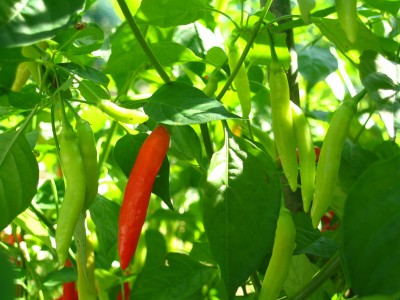
  • These little "Ishigaki" chillis are also very hot, but aromatic too.

    These little "Ishigaki" chillis are also very hot, but aromatic too.

    The other chillis I try to grow are a standard Malaysian “red chilli”: biggish, medium heat and a nice red colour, and what I call “Ishigaki” chillis. Some years ago we got some chillis in the market that were marked as being from Ishigaki island in Okinawa. These were the typical “shima” chillis – somewhat cone-shaped, very hot but with little aroma, possibly related to the Thai chilli. I saved the seeds and planted them next year, but what came up was different. This is not so surprising; commercial plants are often hybrids which don’t breed true. The new chillis were straighter in shape, still very hot but with a special fresh, floral aroma, quite different from habaneros. What was surprising was that they have bred consistently since then; each year seeds saved from the previous crop produce the same kind of chillis. This year they’ve done especially well.

  • min. temp. 7°C max. 19°C